Blaisy Bas: A Bit of History
The village lies at the head of a river valley – the valley of the Oze, which rises in the combe to the south. It is watered by several other streams and this probably accounts for its original settlement. The valley floor makes it fertile, the streams provide irrigation.
The village is not well documented, and has not been the subject of much research, so it is not known for certain when it was first settled.
A Roman road passes along the ridge to the west and Roman remains are plentiful in the area, notably at Malain, where an extensive settlement has been excavated. It is possible that there was a settlement at Blaisy Bas before that, but no evidence has been found.
The names appears as Blacia in 875AD. The road layout suggests a medieval origin for the modern village. In 1147 a mayor is recorded who, in the opinion of the village's historian, Jean Bolnot, was 'in reality a sort of steward who administered the village and the castle [at Blaisy Haut] for the seigneur.
The star shape suggests a crossroads with a market place at the junction. Four of the roads are in use today as departmental roads, but there are at least two others. The original crossroads is now the Place du Jet d’Eau. The dead-end which leads out of it to the west continues as a track which crosses the ridge to the village of Bussy-la-Pesle. It was in use as a footpath through the woods until the 1970s.
Another road that is now no more than a footpath leads south-west from the Rue de Bussy up the side of the combe. At one point it is a sunken track more than 3m deep.
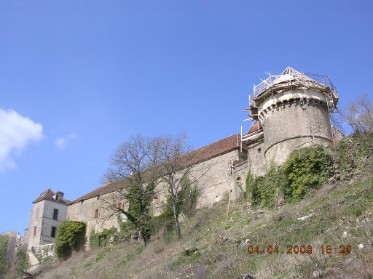
It is not clear whether Blaisy Bas was originally an independent settlement or whether the original settlement was at Blaisy Haut, on a fortified spur that that later developed into a castle, some of the population subsequently moving down into the valley when the need for defence was less pressing.
Until the Revolution, Blaisy Bas formed part of the seigneurie of Blaisy Haut. The castle continued to have a military role until 1593, when it was sacked by the troops of the Baron de Vitteaux during the Wars of Religion.
No documentary evidence for a medieval market or fair in Blaisy Bas has survived but the layout is typical of a settlement grouped round a market place. This was once much larger than it is today. The building that contains the butcher’s shop and firemen’s headquarters is a later addition, as are, probably, the houses that now form the west side of the Rue Chagnot, leading to the village of Turcey. The position of the church, high up at one end of the market place is also typical.
Whatever prosperity Blaisy Bas may have enjoyed had disappeared by the C17. An enquiry for tax purposes on behalf of the king, the Enquete Bouchu, records that in 1668 there were only 50 inhabitants, including widows, all very poor. The state of the buildings may be judged from a report in 1702 that 16 people were killed when a building collapsed. There is no record of what sort of building it was (a house? a barn?) or where.
On the other hand, the seigneur prospered. In 1695 the barony, held by Anotine Joly, was raised to a marquisate. His predecessor, Georges Joly, had spent some of his wealth, in 1680, in funding a maison de charite served by two 'Grey Sisters'. The Jolys were lawyers in Dijon, where Georges was president of the 'grand conseil'. Antoine was a member of the Parliament of Burgundy, in reality an appeal court which also had the constitutional role of registering the king's decrees. Its political power came from its right to object to any decree.
Studies have shown the ruthless way in which seigneurs exploited their fiefs throughout the C18. The attitude of the Jolys is indicated by the fact that in 1727 the inhabitants of Blaisy Bas were still 'mainmortable'. This meant that any land in the fief whose inheritor did not live in the fief passed to the seigneur on the death of the owner. It was one of the most important ways in which seigneurs increased their land holdings over a period of time, at the expense of poorer villagers.
The inhabitants of Blaisy Bas did not buy their release from the condition of mainmorte until 1727, very late for this part of Burgundy, and then only by agreeing to pay 20 sols every year for every 'hearth'. A hundred inhabitants attended the meeting to sign the release document.
Revolution
This, with other surviving seigneurial dues, were swept away by the French Revolution. Blaisy Bas became a commune with a degree of self-government, but no records have survived of the deliberations of the local council until 1814 when Jacques Delaborde is recorded as presiding over the assemblees. Jean Lautrey was elected mayor on 21 May 1815, with Delaborde as his deputy, but Delaborde was mayor later in the year and the following year. Bolnot says the situation is unclear, but presumably Lautrey's brief period as mayor coincided with the return to France of Napoleon. Following his defeat at Waterloo, Delaborde was reinstated.
Coming of the railway
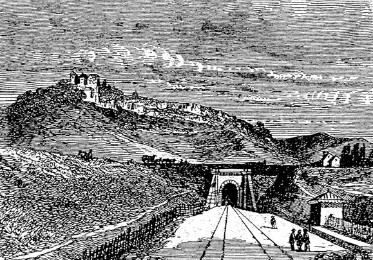
The decision to route the Paris-Lyon railway through Dijon was significant for Blaisy Bas. Thousands of workers from many parts of France, Italy, Belgium and Germany arrived to build the line and, more importantly, the tunnel. They were billeted in villages all around the area and doubled the local population. After they left, railway employees formed an important element of the population of Blaisy Bas but little work has been done on the long-term impact of the railway on the village.
Bolnot talks of the 'construction of shacks and houses, the arrival of inn-keepers and lodging-house keepers and the construction of bread ovens' for the tunnel workers and the architectural evidence shows many small houses suitable for housing working class families.
In 1869 there were 536 inhabitants and it is reasonable to suppose that easy access to Dijon allowed shops to open selling groceries, ready-made clothes and fancy goods and ending the village's historical isolation and self-sufficiency. The size of the station hotel suggests that it was used by commercial travellers as a base for visiting the surrounding farms, taking orders for new machinery, seeds and fertilisers.
C19 and C20 developments
Postcards of Blaisy Bas around 1900 show many shops and businesses in premises that are still recognisable. Bolnot lists 38 different trades that were carried on here. The most important economic activity continued to be farming. Until 1914 farm hands were still being hired for the forthcoming year at the Blaisy Bas fair and there was another fair in September. This practice ended with World War I. A postcard of c1930 shows a bicycle shop and Bolnot records a garage.
The war memorial lists 15 soldiers from Blaisy Bas killed and the churchyard contains the graves of a British solider - Private H Hill of the Royal Army Medical Corps - and three North African soldiers. I assume they died in the hospital run by nuns which survives as a block of flats in the Rue du Couvent, but I have not been able to verify this.
During World War II Blaisy Bas was occupied by a German unit guarding the tunnel, whose soldiers were billeted on the inhabitants. On leaving they attempted to blow up the tunnel but only succeeded in damaging the ends and a few places along the length. The tunnel reopened after repairs in February 1945. Blaisy Bas saw another influx of railway workers in 1947 with the start of works to electrify the line.
The post-war years saw major developments in the infrastructure of the village during 'Les Trentes Glorieuses'. The town hall was rebuilt, the school moved to its present site and the buildings it occupied beside the town hall converted into a community hall. The water supply was improved and culverts provided for the streams which formerly ran alongside several of the roads. Street lighting was modernised. A small barn near the war memorial was converted into a cinema where the cure showed films on a Saturday night, until televison arrived in 1975.
Since the arrival of widespread car ownership in the 1970s many of the village shops closed down. Older inhabitants remember several cafes and a hotel with a dance hall. With a mixed population, Blaisy Bas has held onto more businesses than most of the surrounding villages. There is still a butcher, a baker and a general store. With easy access to Dijon it is an attractive place to live. But the real need for the future is to create new local employment. While suporting this objective in principle, government policy is contradictory, for example in allowing the severe restriction of opening hours of the post office (only saved from total closure by local protests) and the lack of an effective policy for encouraging young doctors to stay in rural areas.